
Step into History in Chester & Delaware Counties
As we celebrate America’s 250th birthday, it’s the perfect time to explore the places where our nation’s story began. From Revolutionary War battlefields and military hospitals to colonial farms and historic villages, Chester and Delaware Counties are rich with connections to America’s past. Walk in the footsteps of soldiers, farmers, merchants and patriots who helped shape the nation. Plus, we’ve included a special detour to nearby Valley Forge — a must-see landmark of the Revolution.
Brandywine Battlefield Park
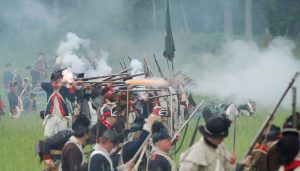 On September 11, 1777, George Washington’s Continental Army faced off against the British Army in the Battle of Brandywine, the largest single-day battle of the American Revolution. Nearly 30,000 troops clashed in a 10-square-mile area. Though the Continental Army was defeated, their resilience proved they could take on the redcoats and live to fight another day.
At the epicenter of Washington’s encampment lies Brandywine Battlefield Park. Admission to the grounds is free, but a ticket (available Fri. & Sat., 10 to 4, Sun., 12 to 4) gets you access to the orientation film, museum and guided tour of the Gideon Gilpin Home, which served as British General Howe’s headquarters. Note: Washington’s headquarters is closed for construction. Check the website and social media for updates.
On August 1, Brandywine Battlefield Park celebrates America’s 250th with “Voices of Brandywine.” A collaboration with the Delaware Theatre Company and Historic Philadelphia, this dramatic retelling of the battle highlights the stories of those who lived through it. Events continue through 2027, the 250th anniversary of the Battle of Brandywine. 1491 Baltimore Pk., Chadds Ford. BrandywineBattlefield.org
Colonial Pennsylvania Farmstead
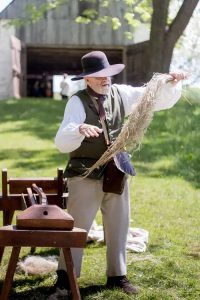 While the Continental Army fought for our nation’s independence, the steady drum of everyday life beat on. Colonial Pennsylvania Farmstead invites you to step back in time and discover the lives of colonial farmers, who made up nearly 90% of Pennsylvania’s early population.
Located in Ridley Creek State Park, this 112-acre working farm and living history site features five restored historic buildings, crop fields, a kitchen garden, orchard and apiary. Costumed interpreters run the farmstead just as it was in the 18th century — horses and oxen plow fields, woodworkers and blacksmiths make essential items, hearth cooks use heirloom veggies and heritage grains grown onsite. Come ready to help with the daily chores!
Colonial Pennsylvania Farmstead holds events and workshops throughout the year. This month, play colonial toys and games (July 5), learn how food was preserved (July 18) and churn your own ice cream (July 19). Don’t miss their Fourth of July event — details on our America 250 page. 4300 N. Sandy Flash Dr., Newtown Square. ColonialFarmstead.org
Historic Sugartown
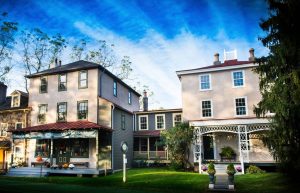 After the American Revolution was fought and won, the residents of Sugartown established a school, general store, businesses and meeting places, creating a vibrant crossroads town for the surrounding farming community. The village became known as Shugart’s Town, after tavernkeeper Eli Shugart, and was a vital stop for weary travelers hauling their goods to the markets of Philadelphia and beyond.
Today, Historic Sugartown is a restored 19th-century village, offering a window into early American life. From May to November, take a 90-minute guided tour of the village (Sat., 11 to 4, Sun., 1 to 4) and visit the general store and school room exhibit, Carriage Museum, c. 1805 Garrett House, book bindery and bank barn.
The village also hosts workshops and special events. This month, take a bookbinding (July 11) or book restoration (July 18) workshop. Then return on August 20 for the Pop-Up Biergarten, featuring Locust Lane brews, food truck bites and a paper marbling workshop. 273 Boot Rd., Malvern. HistoricSugartown.org
Historic Yellow Springs
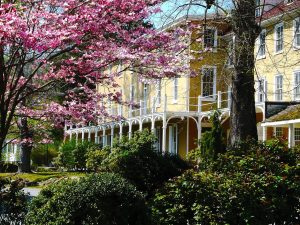 Founded as a spa village in the 18th century, Yellow Springs was the site of Washington Hall, the Continental Army’s first military hospital. George Washington ordered its construction during the brutal winter of 1777–1778, when more soldiers were killed by disease than battle. The hospital laid the early groundwork for modern American medical care, introducing practices we now take for granted — cleanliness, patient isolation, nutritious meals and the use of medicinal herbs.
After the war, the village once again became a spa town. Later, it was home to a school for Civil War orphans, a fine arts campus and sci-fi movie studio (think “The Blob”). Today, Yellow Springs is a place to study art, history and the environment. Pick up a map in the lobby and explore the village, including the hospital ruins and 18th-century medicinal herb garden. On third Tuesdays, take a guided tour for a “behind-the-scenes” experience.
Of course, Yellow Springs is perhaps best known today as an art studio — register online for classes and workshops. 1685 Art School Rd., Chester Springs. YellowSprings.org
Paoli Battlefield Historical Park
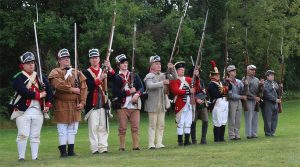 On the night of September 20, 1777, British forces led a surprise attack against General Anthony Wayne’s troops in present-day Malvern. Since the battle took place near the Paoli Tavern, it became known as the Battle of Paoli — or, to the Americans, who decried the redcoats’ use of bayonets and falsely claimed they gave no quarter, the Paoli Massacre. Wayne’s troops swore revenge for this bloody battle, and “Remember Paoli!” became their battle cry.
The 44-acre grounds have remained as farm fields and woods since the battle — making it one of the most pristine Revolutionary War battlefields. A shaded, ¾-mile trail leads you on a self-guided tour, with interpretive panels telling the story of the battle and its legacy. Next to the park, the Paoli Memorial Grounds contain the gravesite of 53 American soldiers and a stone monument erected in their honor — the second-oldest war memorial in the country.
Mark your calendar for Heritage Day, September 26, for reenactors, food trucks and other vendors, and a memorial ceremony. Monument & Wayne Aves., Malvern. PBPFInc.org
Valley Forge National Historical Park
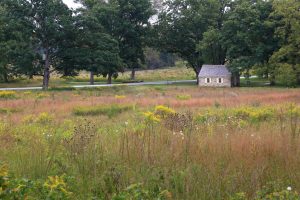
After the British captured Philadelphia in September 1777, George Washington and his army fled to Valley Forge and made camp for the winter. In December 1777, 12,000 patriots, including soldiers, craftsmen, women and children, marched into Valley Forge. Faced with supply challenges and disease, around 2,000 died by June 1778. That said, the winter at Valley Forge transformed the Continental Army from a ragtag group of rebels into a professional fighting force.
Today, Valley Forge National Historical Park attracts nearly 2 million visitors each year. The park protects 3,500 acres of meadows, woodlands, historic landscapes and monuments. The 10-mile Encampment Tour Route takes you to nine major sites, including Washington’s headquarters, reconstructed soldiers’ huts and the National Memorial Arch. Explore by car, bike or trolley — call for reservations. Plus, listen to the audio tour (purchase online) or dial in to the cell phone guide at each stop.
From July 3 to 5, Valley Forge Park is celebrating its 50th birthday — and the nation’s 250th — with special events and programming. Details online. 1400 N. Outer Line Dr., King of Prussia. NPS.gov/VAFO
Our Favorite Resources
- Berk Hathaway Holly Gross
- Chester Cty Community Fdn
- Chester Cty Hosp, Penn Med
- Chester Cty Library System
- Colonial Theatre
- Delaware Museum of Nat & Sci
- Devon Horse Show
- Episcopal Academy
- Hershey’s Mill
- Key Financial, Inc.
- King Construction
- McComsey Builders
- Michael Cook Jeweler
- Monument Sotheby Int’l
- Natural Lands
- Osher Lifelong Learning
- Pennsylvania Hunt Cup
- Tim Vaughan
- Villa Maria Academy