
Brandywine Stories: Wagons Ho!
Remembering the Bicentennial Wagon Train
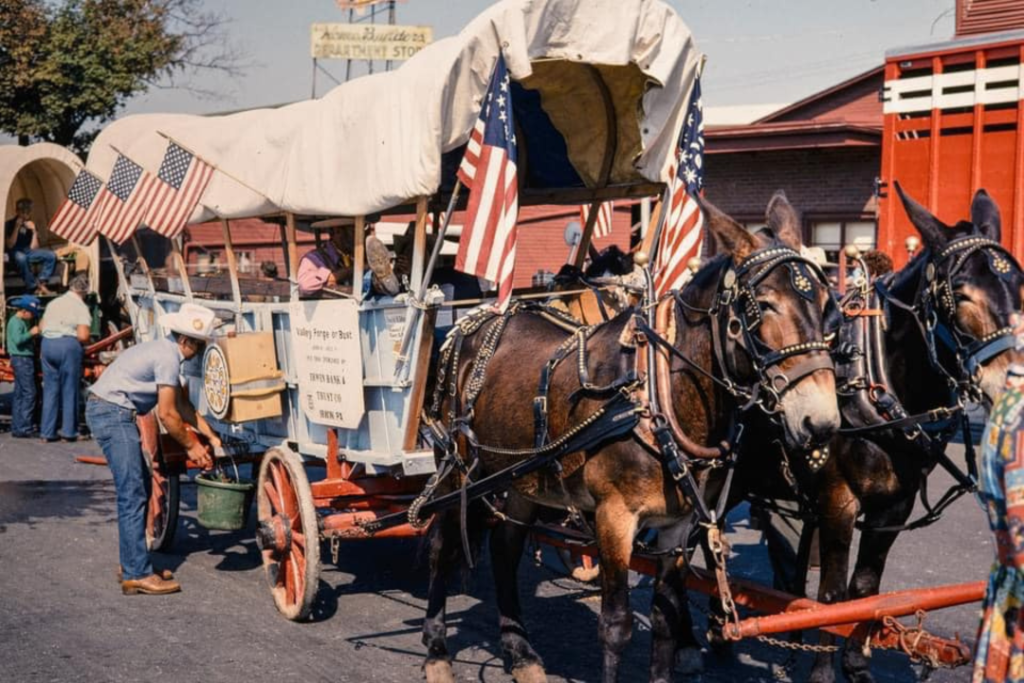
As Philadelphia marks America’s 250th anniversary with sporting events, community festivals, fireworks and parades, this celebration reawakened memories of our last major national milestone — the Bicentennial. Then, as now, Americans found ways to come together to remember the best things about our communities and our nation’s founding.
Plans for the Wagon Trains
During the Bicentennial festivities in 1976, few things captured our nation’s imagination more than the Bicentennial Wagon Train. With 3,000 people driving 200 horse-drawn covered wagons for a year’s journey across the nation, the wagon train planned to converge at Valley Forge. Months of dust, heat, campfires, thunderstorms and laughter culminated in a celebration that announced the creation of Valley Forge National Historical Park.
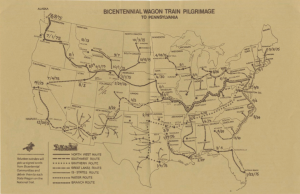
The Pennsylvania Bicentennial Commission envisioned America’s 200th as an opportunity to showcase the Commonwealth’s key role in the nation’s founding and expansion westward. Pennsylvania created the “Wagon Train Pilgrimage to Pennsylvania,” billed as a “replay of history — in reverse.” Costing more than $3.5 million, the project counted 50 states participating — all supplied with an official wagon and two teams of horses, a station wagon, house trailer and period-correct clothing.
Huntingburg Wagon Works of Jonesboro, Arkansas crafted a total of over 50 Conestoga wagons, Prairie Schooners and chuck wagons using authentic plans and building methods. Modern improvements included fitted hard rubber tires and steel axles to handle paved roads, as well as water-repellent and fireproof canvas covers. State delegations from the original 13 colonies drove Conestoga wagons and the rest, Prairie Schooners.
The Wagon Trains
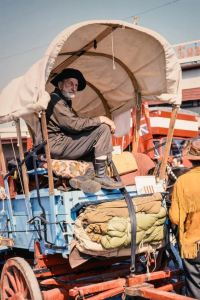
The pilgrimage kicked off from Blaine, Washington in June 1975. Nicole Keegan, an East Vincent Township resident, was there, along with her father, George Keegan, who managed the Northwest Wagon Train. His job was to venture ahead to scout out roads, coordinate with city officials and arrange encampment sites.
“I was 6 years old. It was such an incredible experience for a kid,” Keegan remembered. “The adventure of it all — being a cowgirl! I grew up in Philadelphia, so being able to ride on a horse, to see the cowboys and all the characters — people hanging out, gathering around campfires, making breakfast together — it was so authentic. The people were the real salt of the earth. There were horse races at night, and I remember running through the wagons at camp. I looked up to these people — the cowboys were so impressive!”
The Northwest Wagon Train overwintered in Wyoming and South Dakota, resuming its journey in April. Moving at a rate of 20 miles per day, the Southwest and the Southern Wagon Trains embarked in January 1976, followed by the Great Lakes and Thirteen States Wagon Trains in April. Official state wagons were joined by independent wagons driven by families and groups of friends.
Morgen Stauber Bernard of Texas journeyed with her parents from Oklahoma. She fondly remembered learning about the Amish when reaching Pennsylvania. “They were just as interested in us. They would drive their horse and buggies past us plodding along at 4 miles per hour, laughing and waving at how slow we were. But they were also delighted to see us ‘like’ them in horse and wagon. Sometimes they invited us to a home for a meal. That’s where I learned about the treat of homemade root beer!”
Arrival at Valley Forge
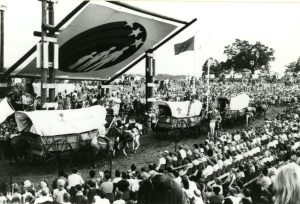
Ultimately, the six wagon trains carrying their hot, dusty and road-weary travelers converged outside Valley Forge on July 3, 1976. Residents lined the streets of Pottstown, Downingtown, Exton, Rose Tree, Lansdale, Phoenixville, Conshohocken and other towns to watch.
Valley Forge Park Alliance Board Chair Scott Sibley, a high school senior that summer, attended the parade through Conshohocken. He and his friends wore commemorative T-shirts purchased from Flacco’s Shoes that read “Conshohocken — the Gateway to Valley Forge.”
The 200 covered wagons entered Valley Forge Park and paraded past the impressive viewing stand as people crowded the fields around them. Afterwards, the delegations unhitched the official state wagons and displayed them near the National Memorial Arch. They remained there until the fall of 1976.
Birth of a Historic Park
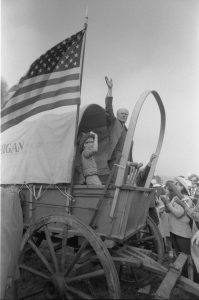
Crowds gathered once again on the morning of July 4th to watch as three Marine helicopters descended, one carrying President Gerald R. Ford. The wagons formed a backdrop as President Ford and Pennsylvania Governor Milton J. Shapp celebrated Pennsylvania’s gift of Valley Forge State Park to the people of the United States in honor of America’s Bicentennial. Valley Forge National Historical Park became the 283rd unit of the National Park System.
This year, as Valley Forge National Historical Park turns 50, wagon train members look back fondly on those long days full of camaraderie on the trail. They created something special for America in 1976 — memories for children who watched them pass and a sense of shared celebration that made the Bicentennial feel close to home.
For information about Valley Forge National Historical Park 50th Anniversary Commemorations, go to NPS.gov/VAFO.
Eastward Ho!
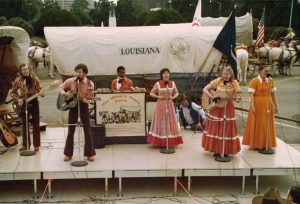
Each Wagon Train route had its own traveling show. Written and produced by Penn State University faculty, “Eastward Ho” brought music, costumes and a little old-fashioned showmanship to the camps each night on the way to Valley Forge. Performers in prairie skirts, vests, jeans and cowboy boots sang songs like “Jubilee Joe” and “We Haven’t Discovered America Yet.”
Earl Reinhalter, who performed on both the Louisiana and Great Lakes routes, remembered that southern audiences were chatty, while northern groups sat and listened more quietly. He also remembered the food: plenty of chicken gumbo in Louisiana and brats in Minnesota.
 Heather Reiffer is part of the Chester County Community Foundation’s America 250 initiative and a nonprofit consultant. She wrote this article to raise awareness of Chester County’s role in our nation’s fight for freedom and build engagement for 2026, the 250th anniversary of the Declaration of Independence. Special thanks to Morgen Stauber Bernard, Josh Gould, Peggy Hartzell, Nicole Keegan, Earl Reinhalter and Scott Sibley for sharing their experiences and photographs and to Rose Fennell, Superintendent, Valley Forge National Historical Park, for her support. To learn more, America250ChesCo.org and CCCF250.org.