
Row Your Boat … Gently — or Madly — Down the Stream
Sculling on our local rivers
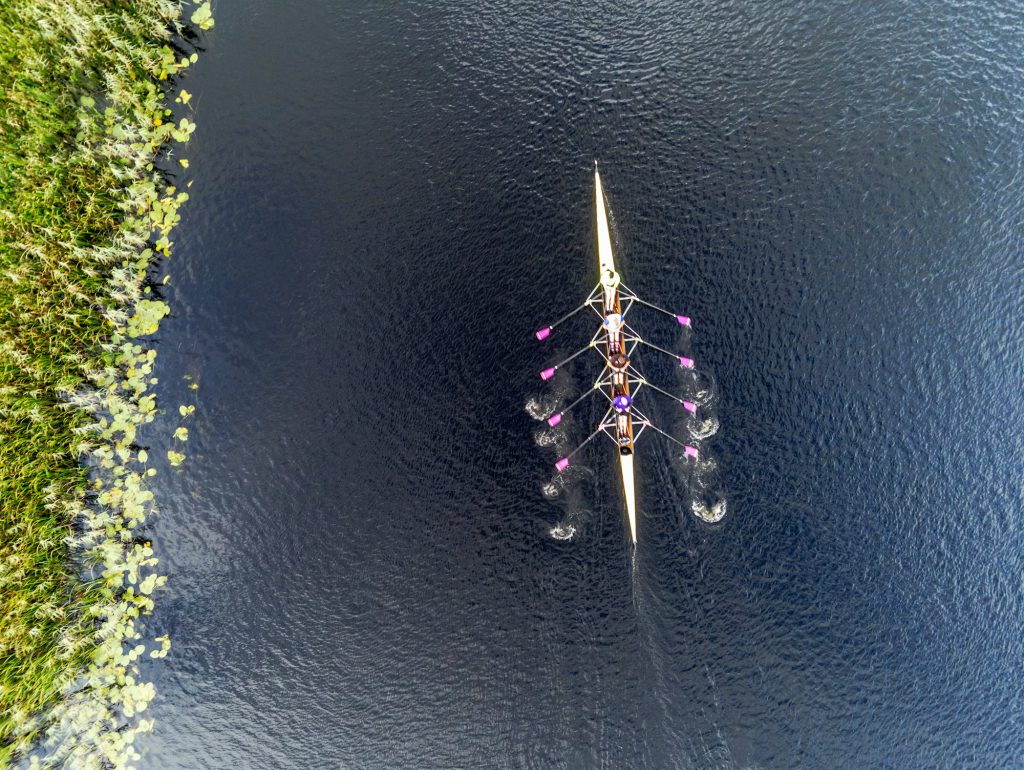
There are several certain signs of spring. Warming temperatures. Blooming trees and flowers. Birds chirping. But there’s no surer sign of spring’s arrival than when the ice breaks and rowers begin their strokes. The Schuylkill, Christina — and, lately, the Cooper — Rivers come alive!
Perhaps you’ve seen Cassatt’s “The Boating Party,” Monet’s “The Row Boat” or Homer’s “Rowing the Boat.” All date to the 1800s. Yet at some level, rowing hasn’t changed very much. After all, you still row backwards. But how to get into a boat, propel it, care for it, repair it and dress for a day on the water … well, that’s very different. Think closer to the movie “The Boys in the Boat” about the 1936 Olympic team. But with higher tech gear.
Here’s a short introduction to the boats and equipment, clubs and regattas, and how to get started rowing.
Boats and Oars
Singly or in groups of two, four or eight, the crews carry their boats (also called “shells”) to the river’s edge and carefully place them in the water. Some are single shells: one rower, two oars. Some are doubles, quads or octuples — two to eight rowers, with two oars per rower.
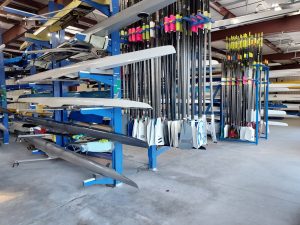
Others are equipped for “sweep rowing,” usually for racing, when each rower handles just one oar. On these boats, the crews row in pairs: two, four or eight. The sweep oar is larger and longer than for sculling.
All the boats are surprisingly light for their size. A singles boat, made of carbon fiber, weighs only about 30 pounds, although it’s 26–30 feet long and a foot wide. An eight-person boat — an “eight” — is about 200–250 pounds, less than two feet wide, yet 60 feet long. The eight-person scull may seem immense on land, especially compared with its smooth, sleek performance on the water.
Although the boat’s weight is light, the cost is surprisingly high. A new one-person scull may run as much as $15,000 for an elite carbon fiber boat. An eight may sell for $70,000–$80,000. Sadly, these beautiful crafts are easily damaged from things like collisions with river debris, docks and other boats. Repair costs add up, so the clubs do much of their own small fixes.
Clubs
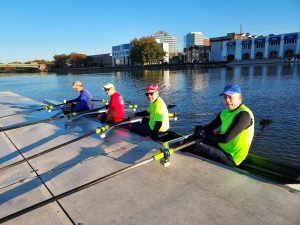 Most of the boats are owned by clubs such as the Whitemarsh Boat Club or Wilmington Rowing Center.
Started in 1984, the Wilmington club currently has 190 members, 51 club boats and about 35 private boats that rent space. Since 2012, the club has operated out of a 10,000-square-foot clubhouse on the Christina River.
The Whitemarsh club was started in 2005, operating out of the Hines Rowing Center in Conshohocken on the Schuylkill River. It currently has about 200 members, 57 club boats and about 45 private boats.
Standard memberships in a rowing club run about $900 per year, more for the competitive program.
Rowers
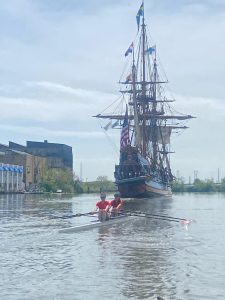 Most rowers are young, broad shouldered, smaller waisted, with powerful legs. Or so they appear. Most are in their teens or 20s. They’re often drawn from local high schools and colleges. Villa Maria Academy High School, Malvern Prep, Episcopal Academy, the Haverford School and Tower Hill School all have teams, as well as Villanova University and Haverford and Bryn Mawr Colleges, along with others.
Nevertheless, the rowing teams — and rowing generally — may only skew young. Onie Rollins, Membership Chair of the Wilmington club, shared that some of its 190 members are in their 80s. Although she herself once competed, she now rows “to be in good shape and be out on the water.”
Marie Leonard, Administrator of the Whitemarsh club, agreed, noting that some members are in their 70s and 80s. She emphasized that rowing is a “life sport,” offering a “full-body, low-impact” exercise. Most older rowers find, even when they’ve been away from rowing for a while, the sport is still familiar, “like riding a bike.”
Clubs, Competitions and Regattas
Both Rollins and Leonard are proud of their clubs’ competitive success. Leonard noted that the Whitemarsh club is one of the “top 20 in the country,” typically making it to “Nationals” (USRowing RowFest National Championships), this year in Ann Arbor. Several members from its masters’ program also go to the “Worlds” in Bled, Slovenia (World Rowing Championship).
But competitive rowing is not easy. In winter, there are almost daily workouts on the erg machines (short for ergometer, a specialized, high-intensity indoor rowing machine) and frigid practices on the river come spring. Spring and summer’s regattas will test the athletic endurances and drive of the teams. See “Regattas” below.
Inside the Boat
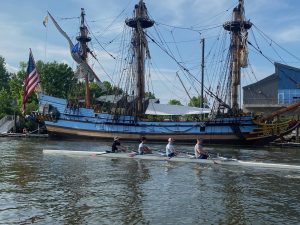 Acting through its oars, the rowers are, basically, a boat’s entire propulsion system. Externally, the boat’s “riggers” enable the oar to act as a lever. Internally, the boats are equipped with rolling, adjustable, cushioned seats designed to slide along a track with each stroke.
Let’s not forget the coxswain (pronounced kok’-sun), who’s responsible for steering, safety and motivating the crew. Facing forward, the coxswain sits in the rear of the boat — usually a four- or eight-seater — setting the beat (the pace) of the strokes. Years ago, coxswains communicated with the crew using a megaphone. Now, of course, modern boats are wired with speakers under each seat.
Sculling Attire
Scullers generally wear form-fitting, breathable, moisture-wicking, synthetic clothing, avoiding anything loose-fitting that could get caught in the sliding seat rollers. Unisuits are popular.
Footwear is complicated. On the boat, there are generally specialized shoes bolted directly to an adjustable plate called a “foot-stretcher.” Moisture-wicking socks will keep feet dry, but that, of course, is once you’re in the boat. Clogs or sandals to slip out of are needed on the dock as you board, plus a shoe with a minimal cushioning for indoor practice.
Learning to Row
Most clubs offer some type of “Learn to Row” classes. For the inexperienced, these classes are the gateway to rowing.
A beginner’s course is offered at the Wilmington club. In May and June, on six consecutive days, from 6 to 8 in the morning and 6 to 8 in the evening, in classes of eight, the club offers coached classes, teaching different parts of the boat, how to take the boat down to the dock, how to set the boat properly in the water, how to get into the boat, what to do if you flip, and details on proper rowing strokes.
Similarly, at the Whitemarsh club, you can take a three-week, 10-class course. There’s also a camp in the summer.
Next Steps
After completing the initial course, if you want to continue rowing — most do — you can sign up for the club’s recreational program or join the competition program.
The rules vary somewhat, but recreation programs generally allow you total access to the club’s boats, to reserve a boat whenever you want, subject to availability. If you want to join a crew, you’ll have to find one among the members. But you can always take out a single scull.
The competitive program requires more structure, commitment and cost. Coaches assemble their teams and create a regular practice schedule. You’ll need to stick to it, in part as a commitment to your team members.
Whether you choose the recreational or competitive route, you’re choosing a sport that combines the brilliance of the outdoors with a driving, heart-thumping workout. Grab an oar! Stroke!
Learn more: Wilmington Rowing Club hosts open houses for tours, info and Learn to Row classes, April 11 & 12, 9 to noon. Whitemarsh Boat Club offers private tours, plus US National Learn to Row Day on June 6. Check their websites.
Regattas
- Jefferson Dad Vail Regatta. Held on May 8 & 9, historically hosted on the Schuylkill River. With over 60 teams, it’s the largest collegiate regatta in North America and key to the Nationals. For logistical and safety reasons, it was moved to the Cooper River in Pennsauken, NJ in 2023.
- The Stotesbury Cup. Held on May 15 & 16 on the Schuylkill River, with over 5,000 high school competitors (more than half female), the largest high school rowing regatta in the world.
- Diamond State Masters. Held on June 20 & 21 on the Christina River at St. Andrews School in Middletown, DE.
- Independence Day Regatta. Three days, July 24–26 (delayed for Philly 250 celebration and FIFA World Cup), open to all, held on the Schuylkill River.
- Navy Day Regatta. Held early October generally on the Schuylkill River and open to masters, open, collegiate and juniors.
- Head of the Christina. Held on October 4 on the Christina River, featuring juniors, high school, collegiate, open and masters.
- Head of the Schuylkill. Held on October 24 & 25 on the Schuylkill River, featuring juniors, high school, open, masters, college, para (for the physically, visually or intellectually impaired) and championship events.
For more, see RegattaCentral.com.