
White Acres Farm
Restoration and expansion of the historic Dowlin House for a modern family
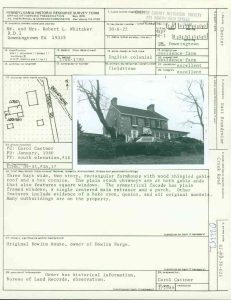
 “Three bays wide, two stories, rectangular farmhouse with wood shingled gable and a box cornice. The plain box chimneys are at both gable ends that also feature square windows. The symmetrical façade has plain framed windows, a single centered main entrance and a porch. Other features include evidence of a bake oven, quoins, and all original mantels. Many outbuildings are on the property.”
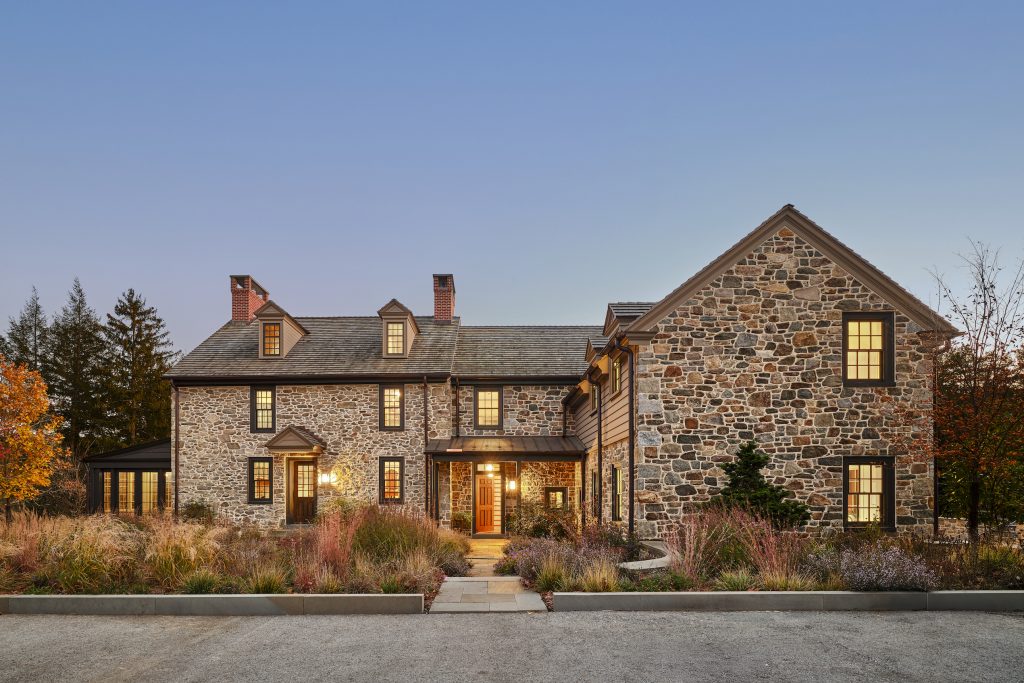
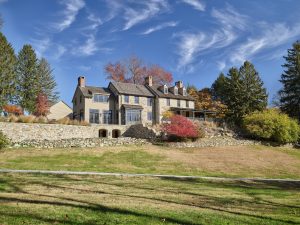
That’s the description from the Pennsylvania Historic Resource form for the original Dowlin House, a simple English Colonial fieldstone farmhouse that was transformed by John Milner Architects into this year’s Fine Home. As with many historic properties in the Brandywine Valley, there are stories behind the property, its name, and the process of preserving, reimagining and decorating the home for a modern family and future generations.
Story of Dowlin Forge
 Along the east branch of the Brandywine Creek, two miles north of Downingtown in Uwchlan Township, are the ruins of an old iron forge. Established in 1785 by Samual Hibberd and sold to John Dowlin in 1801, this forge operated into the middle of the 19th century. The surrounding area grew into a thriving community known as Dowlin Forge.
The forge processed pig iron rods into wrought iron and later plate iron. It flourished, employing a hundred blacksmiths and supplying the Brandywine Ironworks and Nail Factory operated by Dr. Charles Lukens, later the Brandywine Ironworks run by his wife, Rebecca Lukens.
During the three generations of family ownership, the Dowlin family’s property holdings increased to 2,000 acres, encompassing the forge, grist mills, a sawmill, denim factory, company store, a school, worker’s housing, several farms plus forest land for making charcoal, according to Susannah Brody’s research in the 2018 Chester County Historic Preservation Newsletter. In 1854, William Dowlin succeeded in bringing a railroad to the area, the East Brandywine and Waynesburg Railroad Company. Today, the Struble Trail follows the old railroad right-of-way.
Because of its reputation for a high-quality product, Dowlin Forge prospered long after its competitors, though ultimately closing around 1875 due to the rise of steel production. Although the grist mills and other operations also gradually closed, the Dowlin family continued to own lands there through much of the 20th century.
A walk along the scenic watershed and forests of the Struble Trail makes it difficult to image its industrial past. As Brody wrote, “150 to 230 years ago the lands … were alive with the sounds, smell and activities of the grist mills, blacksmith, sawmill, farms, charcoal hearths, wagon teams, water wheel and iron forge — the community once known as Dowlin Forge.”
Story of the Dowlin House
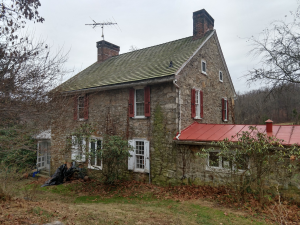 Part of an agricultural complex, the historic Dowlin House is set on rising ground west of North Creek Road, among rolling fields near the edge of a flood plain of the Brandywine Creek. Built in 1799 by wheelwright Jesse Stringfellow, who bought the property for 200 pounds, the stone house, stone barn and springhouse were part of a working farm raising wheat, rye, Indian corn, oats, potatoes and 10 tons of hay, along with livestock — horses, milk cows, cattle and swine. The property was sold in 1854 to Augustus Dowlin, owner of the forge, who owned the property until 1884, when he died intestate.
Since that time, many other families took stewardship of the farm and house, including Jesse Pollock in 1886, John Bowman in 1923, Henry Brooks in 1934 (after years of disputed ownership), Charles Perrin in 1937, David Wilmerding in 1948, and Robert Whittaker in 1955, when the property came to be considered a “hobby farm.”
The current owners of Dowlin House and White Acres Farm have revitalized both house and farm.
Story of the Renovation and Expansion
 It’s not surprising that John Milner Architects was chosen for this project. Founded in 1989, it’s become a leading historic preservation and adaptive reuse firm because of its expertise in understanding, analyzing and sensitively transforming historic buildings for modern use.
Under the guidance of firm Principal Joshua Kiehl, who noted “the property was beautiful, with original character, and respectfully modified,” the goal was to renovate and expand the existing 1799 historic house to serve as the new owner’s primary family residence. This involved work on the original structure along with building a substantial addition that added nearly double the square footage of the stone farmhouse.
Original Home
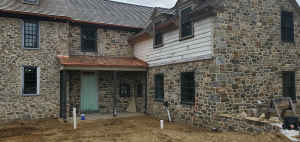 In the original fieldstone farmhouse, the layout of the rooms was largely unchanged, keeping three rooms on the first floor and bedrooms upstairs. The first-floor space includes a formal living room, dining room and music room.
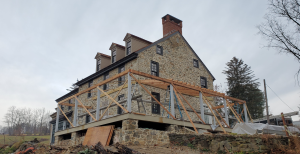
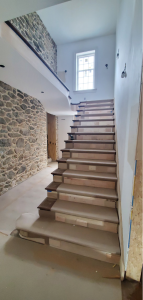 Work on the original structure included such necessary projects as replacing roofing and non-original windows and reframing deteriorated interior floors. To the extent possible, care was taken to salvage and reuse existing framing, hardware and other materials.
On the exterior, masonry was cleaned and repointed and an existing three-season room and porches were reconstructed with increased depth. A wider wraparound porch was installed to provide outside living space for enjoying the views of the valley.
Other changes to the original building included adding dormers at the third floor — creating space for a guest suite — and adding a new entrance on the north side, where it’s believed an original door had been located. A kitchen, added mid-20th century, was removed because a modern replacement was planned for the addition.
The Transition
 It’s a truth universally acknowledged that every modern family needs a big kitchen and family room. The cherry on top is a spacious primary suite removed from kids’ bedrooms. That was the plan for the addition.
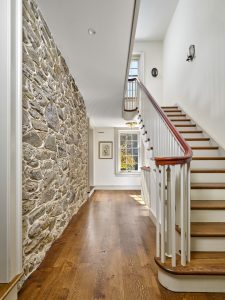
But how to add such a big dream to a modest classic farmhouse? Two key concepts made for a sensitive solution. First, a transitional space, which Kiehl called “the hinge point,” was needed for a smooth flow from the old to the new. To that end, a new entry and stair hall was created to link the existing historic house to the modern addition. This approach allowed exposing the original exterior west stone wall of the house within a stunning, new two-story stair hall with an open and airy feel, foreshadowing the new space.
 And second, the roof lines of the two-part addition were each stepped down from the roof line of the original home. Though large in terms of square feet, the addition did not overpower the historic structure since both sections presented lower rooflines. Inside, the transition evolved through two sets of steps — down to the stair hall, then down again to the kitchen, explained Kiehl.
The Addition
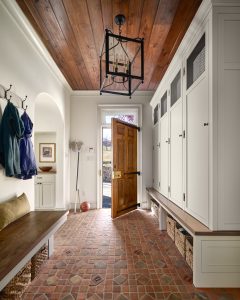 “The original house is situated on a very steep slope that drops away sharply to the south and west, so the addition was configured in an L-shaped plan, turning to the north to avoid the drop,” said Kiehl. This required digging into the slope to situate the laundry and mudroom.
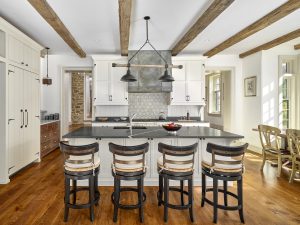
The addition includes a kitchen, family room, laundry room and mudroom entry on the first level, with a primary bedroom suite on the second. The modern kitchen included amenities like a large central island, marble pastry stone and breakfast nook in a sunny bay window. With the additional three common rooms and bedrooms in the original space, a historic property became a comfortable home.
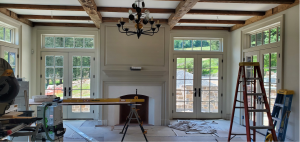 In building the addition, the intent was to create bright interior spaces to serve the needs of an active family. Higher ceilings, large and multiple windows plus French doors provide light and a sense of spaciousness. Simplicity in design honored the feel of the original structure — “maintained, not replaced,” added Kiehl.
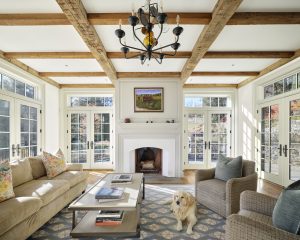 While choosing details for the project, traditional materials and craftsmanship were emphasized, including Okie-inspired Colonial Revival features. “Construction used materials such as natural stone (from Rolling Rock Stone in Oley Valley), plaster, reclaimed timber beams, cedar siding and cedar roofing, and mahogany exterior doors and trim,” said Kiehl. For example, the mudroom ceiling is clad with walnut boards milled from trees on the property.
Decorating to Honor Past and Present
 Decorating a historic property requires more than good taste. Challenges posed by low ceilings and narrow stairs must be navigated with ingenuity. Interior designer Barbara Gisel explained the need to find low-profile overhead fixtures (low ceilings in old homes) from sources she’s cultivated and period-appropriate lighting fixtures from antiques shops and auctions.
As for other challenges: “We took a bathtub up to the third floor for installation before the walls were built around it,” she said of the Dowlin House project. “And the steep-pitched roofline on the original third-floor inspired built-in bookshelves under the eaves.”
 “Most important is to get a sense of what the client wants. Here it was light and bright, plus livable yet simple to match the style of the original house, using old materials,” she continued.
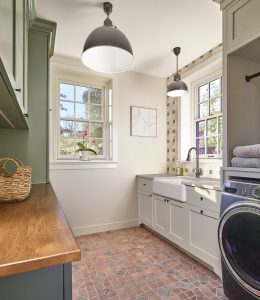
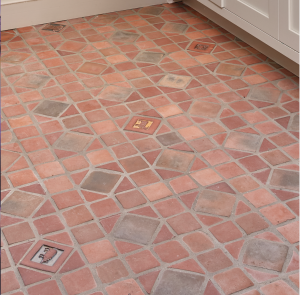
An example of attention to detail and history is found in the clay tiles used. Handmade Mercer tiles, from the Moravian Pottery and Tile Works in Doylestown, were handpicked for a mix of craftsmanship, history and distinctive beauty not found in mass-market options.
One of many special touches paying homage to history, yet responsive to modern needs, and ultimately creating a timeless new home.
 Structural Engineer: Structural Design Associates
Civil Engineer: Edward B. Walsh & Associates
Interior Designer: Barbara Gisel Design
General Contractor: McGettigan Builders
MEP Contractor: James Brown Plumbing Heating & Air Conditioning
Masonry: Baer Brothers Masonry
Exterior Lighting: Heritage Metalworks
Photography: Brian Lauer / Jeffrey Totaro Architectural Photographer
Our Favorite Resources
- Archer & Buchanan
- Arrowwood Landscape Design
- Ball & Ball
- Berk Hathaway Country Properties
- Berk Hathaway Holly Gross
- Berk Hathaway M. Schwartz
- Canvas Valley Forge
- Closet Factory
- Dayton Lock
- Dewson Construction
- DiSabatino Landscaping
- E.C.Trethewey
- Holland Floor Covering
- Homestead Structures
- John Milner Architects
- King Construction
- Main Street Cabinet
- Martins Flooring
- McComsey Builders
- Monument/Sotheby’s Int’l
- Mostardi Nursery
- Mountaintop Construction
- Period Architecture
- Precise Buildings
- Renewal Dynamics
- Rittenhouse Builders
- Sheller Energy
- Stove Shop
- White Horse Construction
- Windle Design & Construction