
What Kind of Barn Is It?
Photos courtesy of Jane E. Dorchester, Randolph Harris and Nanci SarcinelloChester County has some beauties!
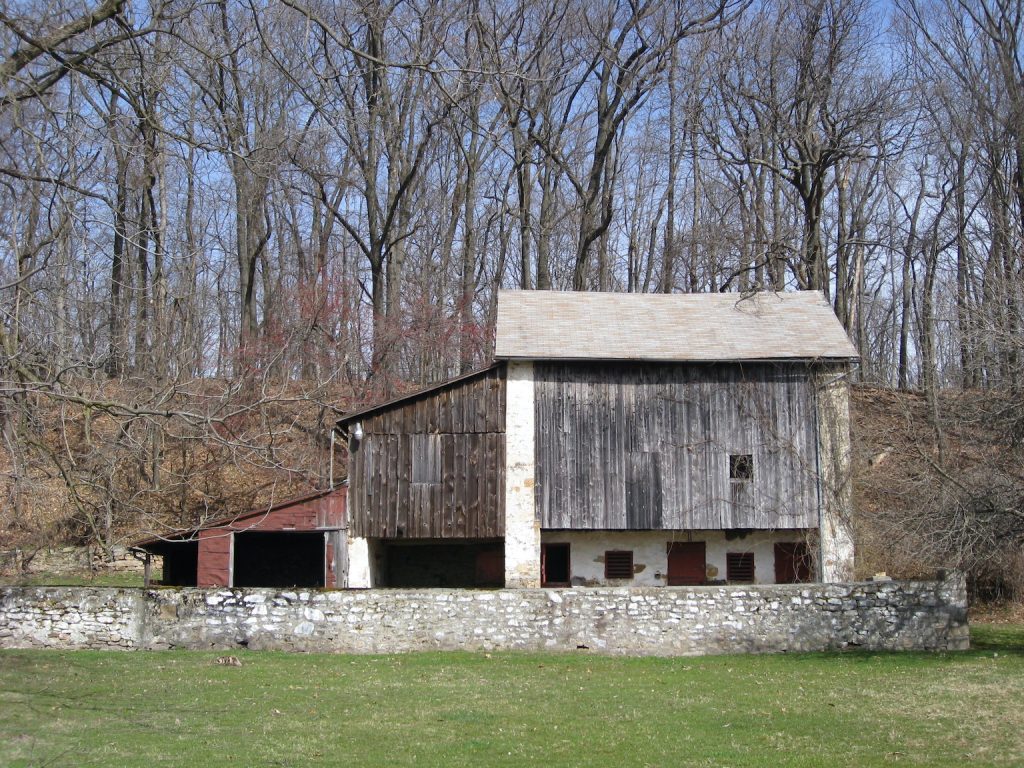 If someone says “Chester County landscape,” what image comes to mind? Many will think of an old stone or frame barn nestled in the slope of a hill. It’s no wonder, since we’re blessed with scores of old barns dotting our land and providing current tribute to our agricultural heritage.
Have you then wondered what kind of barn you’re thinking of or passing as you travel backcountry roads? Well, that’s a challenging question. While there are only three common types of barns located in Chester County, one of those types has quite a few variations. To further complicate the issue, there’s no agreement on names for the different types of barns and their variations.
To try to help understand the history of local barns, I’ll use the same names of barn styles used in Robert F. Ensminger’s “The Pennsylvania Barn: Its Origin, Evolution, and Distribution in North America.” Ensminger is considered an authority on Pennsylvania barns. And I’ll limit this review to only the most common types and variations.
Some Background
A few things you need to know to start. The south or west façade is generally considered the front of the barn. If a barn has or had a forebay — a frame extension overhanging the upper level of the front façade of the barn — it was located on one of those sides. This makes it easy to distinguish the front and rear façades of barns.
The size of the barn doesn’t affect its architectural style — all types of barns discussed here can be found in any size, large or small. With one exception, all the barns in this overview are two-level bank barns — meaning barns built into a bank of a hill, with ramps used on the rear side to access the second level of the barn.
Also noteworthy, as the function of farms changed, so did the types of barns themselves, with modifications made to suit their changing uses. In addition, most barns in this article were originally built of stone with frame forebays (if they had them).
Today, many barns now have frame upper levels that originally would have been made of stone — though this doesn’t change the type of barn. In the photos, you’ll see how some barns have been changed over the years, including adding cow sheds, milk houses and chicken houses, which were attached to the front façades of the barns. And some barns had their side-gable roofs replaced with gambrel roofs — symmetrical two-sided roofs with two slopes on each side — to create more space under the roof.
Here’s a short guide to a few of the most common styles of barns that you’re likely to see on your drives through the Chester County countryside.
Classic Sweitzer Barn (1750–1850)
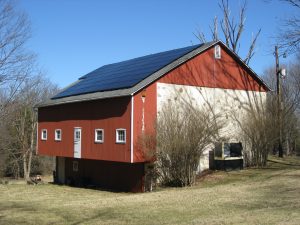
These barns were one of the first types of barns constructed in Chester County. Originally built of logs with a stone lower level, later Sweitzer barns were constructed of stone with a frame forebay, seen in Photo #1.
This type can be identified by the following characteristics:
- Shallow frame forebay
- Cantilevered forebay, meaning the forebay has no posts or pillars to support it. Instead, its roof beams are extensions of the second level floor joists — the signature characteristic
- Side-gable roof with the front roof being longer than the rear roof (asymmetrical)
Lake District Bank Barn (c. 1790–c. 1840)
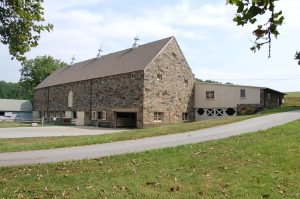
This type of barn is the least common type found in our area, but it’s easily identified because it has no forebay. And yet many Lake District barns had forebays added to them as their function changed. So, you have to look hard to find a classic example like the barn in Photo #2.
Other characteristics of these barns are:
- Stone construction
- Steeply pitched side-gable roof
- May have a pent roof across the front façade between the lower and upper levels — the signature characteristic. A pent roof is a shallow, sloping roof located between the lower and upper levels of the barn, supported by extensions of the second-floor joists.
Pennsylvania Barn (1790–1890)
This is the most common type of barn you’ll see in the Brandywine Valley. Its origins are unclear, but it seems to combine aspects of the classic Sweitzer and Lake District bank barns. There are many variations of this type of barn resulting from changes in construction techniques and the functions of the barn. Here are the three most common types: standard, Chester County and double-decker.
Standard Pennsylvania Barn (1790–1890)
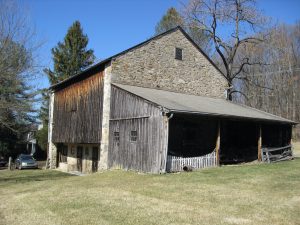
This variation, also known as a closed-forebay barn, is probably the earliest version of this style and has lasted the longest in popularity.
This style can be identified by the following characteristics, seen in Photo #3:
- Shallow frame forebay
- Gable walls extended to support the forebay — the signature characteristic
- Relatively shallow pitched side-gable roof, both sides being of equal length
Chester County Barn (1800–1870)
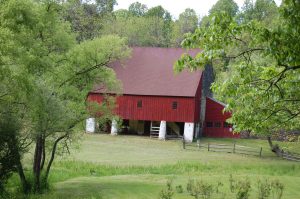
This style of barn is believed to have originated in Chester County, hence its name. Quaker farmers are credited with creating this variation, which was fairly common here. Sadly, these barns are disappearing from the landscape because of land development and replacement of its signature forebay supports with wood columns or posts.
This style can be identified by the following characteristics, seen in Photo #4:
- Deeper frame forebay than the standard Pennsylvania barn
- Relatively steeply pitched side-gable roof with the front roof being longer than the rear roof
- Conical shaped stone piers that support the forebay — the signature characteristic
Double-Decker Barn (1800–1880)
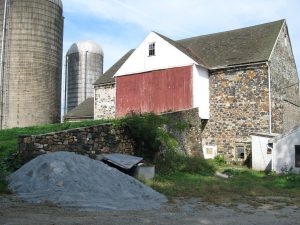
This style evolved with the changing functions of Chester County farms as well as their increasing productivity. While Quaker farmers are credited with creating this variation, it’s notable that examples can also be found in Western Europe.
This style can be identified by the following characteristics, seen in Photo #5:
- Three-level bank barn — the signature characteristic
- Third level accessed on the rear side by a bridge, sometimes enclosed in a frame structure
- Second level accessed on the rear by a double door under the bridge
- Deeper frame forebay than the standard Pennsylvania barn
- Relatively steeply pitched side-gable roof with the front roof being longer than the rear roof
Feel free to use your newfound knowledge of the architectural styles and distinguishing characteristics of barns to astonish your friends during your next backroad drive.
 Jane E. Dorchester has been an architectural and local historian, historic preservationist, lecturer, researcher and writer since 1983. She’s researched the histories of many properties, conducted historic resource inventories and surveys, written historic impact studies, National Register nominations and more. She provides historic preservation consulting services based in East Goshen Township. Contact her at JEditorHSPV@Gmail.com.
Our Favorite Resources
- Aqua Terra Pools & Landscapes
- Archer & Buchanan
- Ball & Ball
- Berk Hathaway Holly Gross
- Berk Hathaway M Schwarz
- Chester County Day
- Compass Real Estate
- E.C. Trethewey
- Holland Floor Covering
- Howard Hanna Real Estate
- Jane E. Dorchester
- Keystone Gun-Krete
- Keller Williams Real Estate
- King Construction
- The Kline Organization
- Latta Kennedy Builders
- Main Street Cabinet
- Martin’s Flooring
- McComsey Builders
- Monument/Sotheby’s Int’l
- NV/Ryan Hones
- Period Architecture
- Precise Buildings
- Pronto Pools
- Renewal Dynamics
- Rittenhouse Builders
- Sheller Energy
- White Horse Construction
- Windle Design & Construction