
Clear Danger
Images courtesy of Liz Pettit and Jenkins Arboretum & GardensProtecting Pennsylvania's bird population
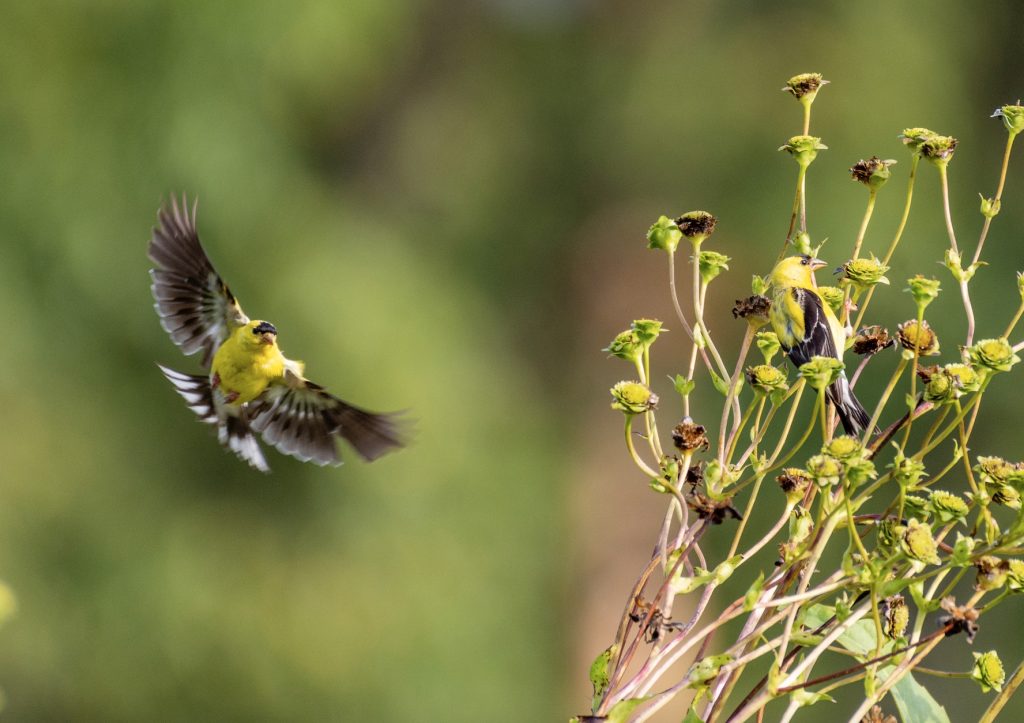 It’s dusk, the sun is slipping low behind the trees, and a bird is in flight. She has dozens of miles to cover tonight. Through her eyes, positioned on the sides of her head, the world zips by in blurs of green, deep blue and brown. Ahead, dusky patches of sky and foliage promise safe passage, an open invitation.
She doesn’t realize she’s looking at a reflection in glass as she zips forward. Not even when her tiny body slams against the solid surface, cutting her flight short. It’s another bird strike.
A Modern Peril
Window collisions like these are an all-too-common occurrence. From a young age, humans learn to associate visual cues like window frames or smudges with the solid, transparent material that is glass. Birds, however, lack the cognitive ability to make this connection. Unable to identify glass, they perceive reflections literally.
At night, artificial light glowing behind windows presents an added danger, luring birds into a maze of urban landscaping that they struggle to escape the following day. The impact of this threat to bird populations is staggering. Every year, over one billion birds die from window collisions in North America alone.
At Home and in Cities
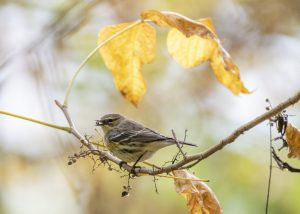
The problem of collisions is as relevant at our own homes as it is at commercial or public buildings. Almost half (roughly 44%) of bird collisions occur at residences. On average, window collisions kill one to 10 birds per home per year. With nearly 149 million residential houses in the United States, the cumulative effect is devastating.
The shared blame for this problem is also the shared responsibility to create change. If every home poses a danger, then every homeowner has the opportunity to take part in the solution.
What to Do
Small, inexpensive home projects make a big difference in preventing fatal bird strikes. Adjustments don’t need to be made to every window of a home to mitigate the danger to birds. Nearly all collisions can be reduced by addressing windows that have already caused accidents: large windows and glass doors that reflect sky or greenery and windows across from feeders, baths or fruit-bearing plants.
Remember, if you see habitat reflected in your window, so do birds.
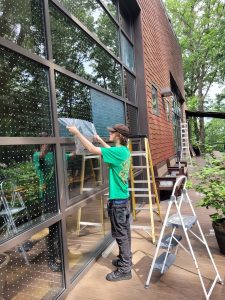
An effective method to make windows collision-proof is to attach patterns to the outside of the glass, giving birds a visual cue that an impassable barrier is in their flight path. Shape, color, size and spacing are all important factors to consider.
Pattern elements should be at least ¼ inch in diameter and spaced no more than 2 inches apart. White markers offer the best contrast for glass reflecting the patterns of trees or vegetation, while black markers are best for glass reflecting the sky. As long as these guidelines are followed, the material used to create the preventive patterns can be as simple as sticky notes, stickers or paint arranged in a grid.
Many products are available for purchase to retrofit home windows, including rolls of ABC BirdTape laid in a checkerboard pattern or Feather Friendly adhesive markers that are installed in strips or sheets. Products are available at a range of prices and sizes depending on your home needs.
If you don’t want to adhere anything to the surface of your windows, you can hang lengths of 1/8-inch parachute cord spaced less than 4 inches apart outside the window (a design known as Acopian BirdSavers). The movement of the cord helps alert birds to the presence of glass.
Bird-proofing your windows can also be a source of color and fun. If you’re looking for a creative personal or family project, try painting designs on your windows with tempera paint in a 2″x2″ grid. Tempera paint can be easily removed with vinegar and water, making it a fast and simple solution that doesn’t require a permanent commitment.
At Jenkins
A diverse array of resident and migratory birds find food and shelter in the gardens at Jenkins Arboretum & Gardens. In the heart of the property is the John J. Willaman Education Center, the hub of activity for programs, workshops, staff offices and art exhibitions. With the intention of blurring the lines between indoors and outdoors, the building features nearly 2,000 square feet of glass windows.
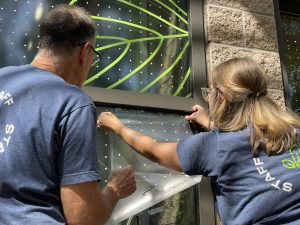
Knowing this building posed a threat to the very birds Jenkins sought to attract, Feather Friendly deterrent markers and Acopian BirdSavers were installed on window surfaces during the summer of 2025. Since installing this simple retrofit, we’ve observed a 100% reduction in fatal bird strikes! A heartbreaking problem was quickly and easily resolved.
Join in to protect our feathered friends with simple solutions. Visit Jenkins to see firsthand how bird-safe windows operate, or purchase bird strike prevention kits in The Garden Shop to protect your windows at home.
The scale of the danger facing birds may be daunting, but the steps to help are not.
Jenkins Arboretum & Gardens is a 48-acre public garden showcasing native flora of the eastern United States and a world-class collection of rhododendrons and azaleas. The gardens are open every day of the year and are always free. Plan your visit at JenkinsArboretum.org.
Our Favorite Resources
- Aqua Terra Pools & Landscapes
- Archer & Buchanan
- Ball & Ball
- Berk Hathaway Holly Gross
- Berk Hathaway M Schwarz
- Chester County Day
- DiSabatino Landscaping
- E.C. Trethewey
- Gordon Eadie Landscaping
- Howard Hanna Real Estate
- Jane E. Dorchester
- Keystone Gun-Krete
- Keller Williams Real Estate
- Latta Kennedy Builders
- Martin’s Flooring
- McComsey Builders
- Monument/Sotheby’s Int’l
- NV/Ryan Hones
- Period Architecture
- Precise Buildings
- Pronto Pools
- Rittenhouse Builders
- Sheller Energy
- White Horse Construction
- Windle Design & Construction