
Brandywine Stories: Horsepower of the Revolution
From war mounts to show rings
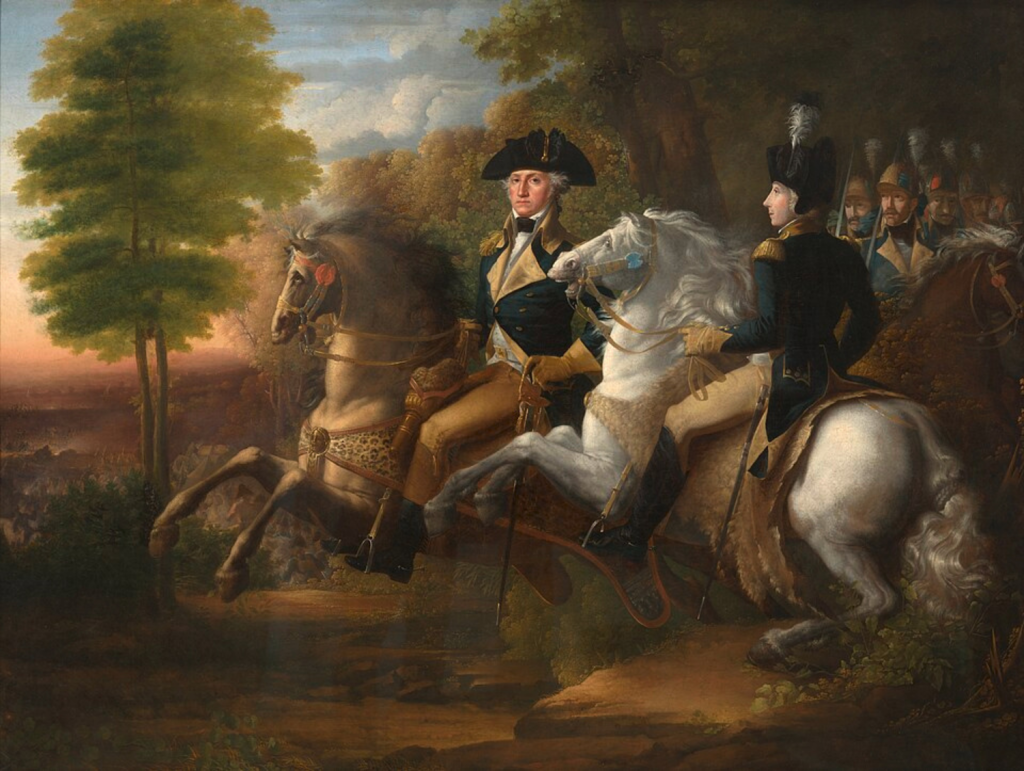
On a quiet morning in Chester County, a rider settles into the saddle, adjusts the reins and asks her horse to move forward. The exchange is subtle, almost invisible, a shift of weight, a quiet cue, a shared breath. Yet 250 years ago, that same exchange might have carried life-or-death consequences.
In the fall of 1777, Chester County’s rolling fields and wooded creeks became a corridor of war. As British General William Howe advanced toward Philadelphia, thousands of redcoats and Hessian troops marched through the county, clashing with Continental forces at the Battle of Brandywine and maneuvering along roads we still drive today. Horses were everywhere: transporting officers, hauling wagons, pulling artillery, carrying messages between scattered units.
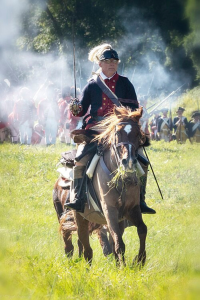
The scale was staggering. When Howe’s army sailed from New York down the Chesapeake in a flanking maneuver, roughly 2,000 horses were packed aboard transport ships for weeks. Many were weakened by confinement, heat and limited water. Fewer than 300 survived to march north through Kennett Square, Westtown and Tredyffrin.
After the battle, British encampments stretched across the county, and farms were stripped of livestock and fodder. The 1782 Chester County Register of Revolutionary War Damages recorded the losses in stark detail. Joel Bailey of West Bradford Township reported that five horses were taken along with sheep and tools. Others listed mares, riding saddles and young colts among their losses. Horses, saddles and bridles appear again and again in these claims.
The plunder was not incidental. Forage was as critical as gunpowder. As historian Paul Mullin recounted in “The Plunder of Chester County During and After the Battle of Brandywine,” British troops camped for days in Birmingham and Tredyffrin, commandeering livestock, crops and supplies. A thousand-pound horse can consume roughly 25 pounds of hay a day. Multiply that by hundreds, or thousands, and the agricultural strain becomes clear. Feeding the army meant emptying local barns along the troops’ travel route.
Today, the stakes are different, but the partnership between horse and rider remains central. Miranda Wade, a Chester County horse trainer, sees echoes of that wartime bond every day. “It’s a very mutual trust,” she said. “The horses have to trust that you’re never going to put them in danger … and you really have to trust them.”
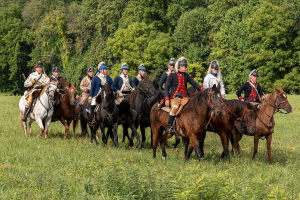
Wade, who also served in the Marine Corps, noted that horses are acutely sensitive to human emotion. In moments of stress, riders must project calm leadership. “As a rider, when your horse is stressed, you really need to be that strong, confident leader and say, ‘Nope, we’re here. I’m here. You’re okay.’”
In 1777, that steadiness could calm a mount amid cannon fire. Officers trained their horses to withstand chaos, just as modern riders condition them for the chaos of the competition ring. Exposure, repetition and consistency built confidence then as now.
Military riding techniques also left their imprint on sport. Classical dressage, with its precise movements and collected balance, evolved in part from cavalry training, where responsiveness and agility were essential. The ability to shift weight, turn sharply or move laterally had tactical value on a battlefield.
Chester County’s landscape helped shape its equestrian sport tradition. Its hills and open fields fostered fox hunting, carriage driving and competitive showing. When the Devon Horse Show began in the late 19th century, it reflected agricultural pride and regional identity. Though disciplines and breeding trends have evolved, the county remains closely identified with horses.
The 1782 register makes clear that horses were not merely property — they were central to both war and rural survival. But then, as now, equestrian culture extended far beyond utility. Wade described what she calls the “mutual calming effect” between horse and human. “You can see when someone kind of nuzzles next to a horse and the horse breathes on them,” she said. “People just sigh.”
During this 250th anniversary of the American Revolution, fields once crossed by mounted scouts now host riders training at dawn. Carriages still circle the ring at Devon. Fox hunters still move across open country. The work is different, but the skills of balance, timing and steadiness are familiar.
Horsepower carried armies through smoke and mud. Today, it carries riders through a show ring. The function has shifted, yet the horse remains woven into Chester County’s identity.
What Happened to the British Army’s Horses?
When British troops marched out of Chester County in 1778, not every horse left with them. Campaign animals that survived the Atlantic crossing, long marches and months of encampment faced uncertain futures. Some were taken north with the army to New York. Others, weakened or no longer fit for service, were likely sold, traded or left behind.
Because armies constantly replaced exhausted mounts with animals seized from local farms, horses could change hands repeatedly. A mare taken from a Chester County barn might carry a British officer one season and return to farm work elsewhere the next. Even in wartime, these animals moved between sides more easily than the men who rode them.
 Kim Andrews is part of the Chester County Community Foundation’s America 250 initiative and a nonprofit governance consultant. She wrote this article to raise awareness of Chester County’s role in our nation’s fight for freedom and build engagement for 2026, the 250th anniversary of the Declaration of Independence. For more information and to get involved: America250Chesco.org or CCCF250.org.