
Brandywine Stories: The Other Revolutionaries — Pennsylvania Women Who Shaped a Nation
Four unsung patriots who fought for freedom in their own way
In 2026, we’ll hear plenty about Washington, Lafayette and the battles that swept across southeastern Pennsylvania. But the Revolution wasn’t won by generals or soldiers alone. It depended on women — organizers, writers, workers and caregivers — many of whom lived in or moved through what is now Chester County.
To commemorate America 250, here are four Pennsylvania women whose stories have long been missing from view.
Esther de Berdt Reed: A Broadside That Became a Movement
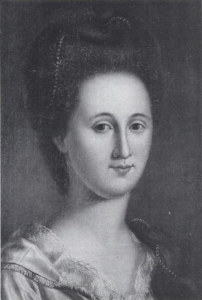
In June 1780, with morale crumbling and the Continental Army short on supplies, Philadelphia’s Esther de Berdt Reed issued a bold broadside in “Sentiments of an American Woman.” Her message was groundbreaking — women could, and should, take public action to support the cause.
She urged women to raise money for Washington’s troops, something wildly unconventional for the time. Within weeks, the Ladies Association of Philadelphia collected more than 300,000 Continental dollars. When Washington suggested the funds purchase shirts, the women bought linen and sewed more than 2,000 garments, stitching their names inside.
Reed’s activism both clothed soldiers and helped establish the idea that women’s civic engagement could shape national life.
Hannah Griffitts: A Quaker Poet’s Pen Against Power
While Reed organized, Philadelphia Quaker Hannah Griffitts wielded her pen. Raised in a community that embraced spiritual equality, Griffitts wrote political poems urging “Daughters of Liberty” to resist British taxes and imported luxuries.
In her widely shared poem “The Female Patriots,” she mocked men who were too timid or too easily bribed by British officials, writing: “If the Sons … the Blessing despise, / Let the Daughters of Liberty nobly arise.” Her work championed boycotts, thrift and speaking one’s mind.
A pacifist, Griffitts was troubled by the war’s violence. She mourned divided families and criticized extremism on both sides, calling Thomas Paine a “snake beneath the grass,” while finding British officers’ revelry in occupied Philadelphia equally distasteful.
Griffitts never sought publication, rather her poems survived because other women copied them. Today they reveal the conflicted loyalties and quiet courage of Pennsylvania women during the Revolution.
Hannah Archer Till: Claiming a Freedom Not Given
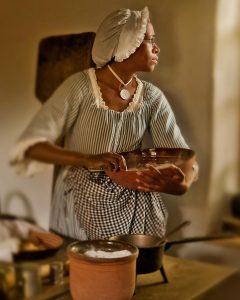
Hannah Archer Till’s life spans slavery, survival and self-emancipation. Born enslaved in Delaware around 1721 to a mother of African descent and a father from the Oneida Nation, she was bought and sold several times, even taken to England before returning to North America.
Trained as a cook, she earned small amounts of money, enough to purchase her freedom, taking the name Archer. She married Isaac Till, and when the Revolution began, both joined the Continental Army workforce. By 1776, she was working as a skilled cook for the Continental Army’s senior command, a role requiring exceptional trust. She followed the army through major campaigns, including the brutal winter at Valley Forge, where she gave birth to a son inside Washington’s headquarters.
After the war, the Tills settled in Philadelphia and joined the First African Presbyterian Church. She lived to be more than 100 years old and is recognized today as a patriot. A DAR chapter carries her name.
Abigail Hartman Rice: Quiet Heroism at Yellow Springs
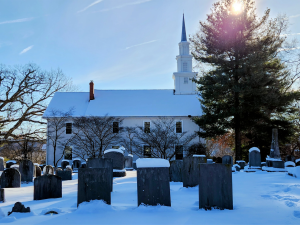
Abigail Hartman Rice’s story brings the Revolution home to Chester County. Born in Germany and raised near present-day Pikeland Township, she married a millwright and raised a very large family from 21 pregnancies, with 17 children living to adulthood.
In 1777, the war reached her doorstep. After the Battle of Brandywine, the Continental Army passed through the region. When the army established a hospital at Yellow Springs in early 1778, Rice became a nurse. Supplies were scarce, medicine rudimentary and disease rampant. During the Valley Forge encampment, more Americans died from illness than in battle, and Rice was among the civilians caring for them. She contracted typhoid fever while nursing the sick and never fully recovered.
Rice’s service was quiet but essential — the kind of everyday patriotism the war depended on.
Examining America 250
These stories are a reminder that the Revolution was not only a political struggle but a human one, carried on by people whose names history often overlooks. As celebrations unfold across Chester County in 2026, perhaps the most meaningful tribute is the widened understanding of who shaped the Revolution.
Esther Reed, Hannah Griffitts, Hannah Till and Abigail Rice each moved history forward in their own way. They show that the Revolution wasn’t fought only by men with muskets and maps but also carried by women whose contributions are finally visible.
Then & Now: Women Leading Chester County
The women of the Revolution — Esther Reed organizing fund drives, Hannah Griffitts wielding her pen, Abigail Hartman Rice nursing the sick and Hannah Till carving out her own freedom — pushed the boundaries of their time. Today, that legacy continues, as 54% of Chester County nonprofits are led by women (Chester Cty. Comm. Foundation, 2024) and nearly 40% of county businesses are women-owned (U.S. Census Bureau, 2023). This is despite women still earning only $0.84 for every dollar men earn locally (PA Dept. of Labor & Industry, 2024). It’s a reminder that women’s influence here is longstanding, growing but not yet fully formed.
The Work of Healing at Yellow Springs
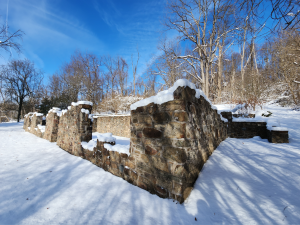
From January through March 2026, Historic Yellow Springs will present a special exhibition on Revolutionary War medicine at Washington Hall, the former Yellow Springs Hospital. Drawing on research materials and historic medical reports, the exhibition explores how this site functioned within the Continental Army’s coordinated hospital system. Among those who provided care here was Abigail Hartman Rice, a Pikeland Township resident who served as a nurse during and after the 1777 Battle of Brandywine, tending soldiers suffering from disease as well as wounds. The exhibition brings the hospital’s ruins to life through the routines, sanitation practices and daily labor that shaped survival.
Historic Yellow Springs, 1685 Art School Rd., Chester Springs. YellowSprings.org
 Kim Andrews is part of the Chester County Community Foundation’s America 250 initiative and a nonprofit governance consultant. She wrote this article to raise awareness of Chester County’s role in our nation’s fight for freedom and build engagement for 2026, the 250th anniversary of the Declaration of Independence. For more information and to get involved, A250Friends.org.