
Brandywine Stories: Revolutionary Kids
How Chester County children lived, worked and learned
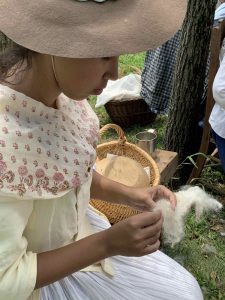
To modern children, the Revolutionary era can be experienced through dress-up bonnets, breeches and wooden toys. Yet for children growing up in Chester County around 1776, childhood was not a costume drama. It was work, family, faith, chores, learning and play amid a looming war.
Most Chester County children were involved in household labor. In a rural community, home and work were often the same place. A child might wake up surrounded by the day’s tasks, with animals to feed, water to carry, weeds to pull, seeds to plant, butter to churn, younger children to watch, fires to tend and food to help prepare. On farms, in mills, in shops and in village households, children were an integral part of adult work.
Get a Glimpse of the Past
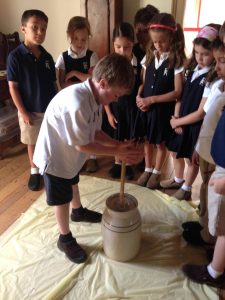
At Historic Sugartown, children visiting today are often drawn first to the hands-on activities they see there, including leather crafting, quill writing, visiting the general store and investigating the tools of everyday village life. And they’re surprised to learn how much responsibility colonial children once carried. A 10- or 11-year-old might have slept near the kitchen hearth in winter to keep the fire going overnight. Startling to consider now, this duty was part of learning how a household survived.
Schooling also looked very different. Public schools as we know them did not yet exist. Some children learned at home, others through churches or subscription schools, and still others through Quaker schools, where literacy was closely tied to religious life.
For most, reading the Bible was central to learning. Girls might also learn through creating samplers, practicing letters, stitches and moral lessons at the same time. In general, education was practical, religious and unevenly available.
Children’s educational opportunities depended on their race, status, gender and wealth. White children in prosperous families had more access to books, schooling and commercially made toys. Poor children made do with what was available.
Enslaved and free Black children faced far more limits. In Pennsylvania, slavery was present even if it looked different from plantation slavery farther south. Black children, whether enslaved or free, often had limited access to education and were expected to work from a young age. Still, like all children, they found ways to play, create and learn within the constraints around them.
And yes, children played.
Colonial Toys and Games
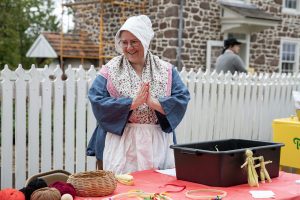
Rebecca Roberts and her 17-year-old daughter Alessandra Johnson, who run Living History Craft & Play, bring colonial games and crafts to public events, schools and community programs while dressed in colonial garb. They find that children are drawn first to objects they’re allowed to touch, in contrast to historic homes where children were often told not to handle anything. At a Living History game table, children are invited to pick something up, toss it, roll it, balance it or figure out how it works.
Alessandra observed that a big difference from today is that colonial children had to be inventive with whatever was nearby. “You couldn’t just go to a toy store and buy a toy,” she said, adding that many Revolutionary-era toys were simple, portable and made from available materials.
Children played with Jacob’s ladders, cup-and-ball toys, hoops and sticks, wooden tops, dolls, pickup sticks (“jack straws”) and games like graces, where two players used sticks to toss and catch ribboned hoops. Some toys were purchased, most often by residents in towns or by wealthier families. Most others were homemade — for example, a doll could be made from fabric scraps, corn husks or burlap. Or a child could turn acorns into a tiny tea set, sticks into a game, or scraps of wood into something to roll, toss or carve.
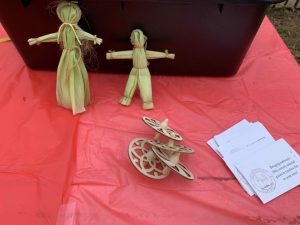
Play often reflected skills children were learning for adult life. Girls who learned sewing could stitch a doll’s dress or embroider a face, while boys learning woodworking or trade skills might carve a pin, hoop or game piece. And as always, children also improvised.
Barry Rauhauser, Executive Director at Historic Sugartown, noted that historians tend to know more about the toys that left physical evidence behind, but children surely invented many more games that no one wrote down, such as creek boats, hand games, chasing games, stick swords, snow play, sledding, hiding and pretending.
Colonial childhood was harder, more physical and more tied to family duty than childhood today. Children had less free time, fewer belongings and far more chores to do. And yet, they were still children. They ran, pretended, made toys, bent the rules and begged someone to watch when they finally got a game right.
That’s what makes Revolutionary-era childhood feel much less distant. Families can still see pieces of it at Chester County History Center, Historic Sugartown, Colonial Pennsylvania Plantation and public programs with living history interpreters. The tools and chores have changed, the world around children has changed even more, but childhood desires to help, imitate, explore, invent and play remain.
Five Things Chester County Kids Would Have Done in 1776
-
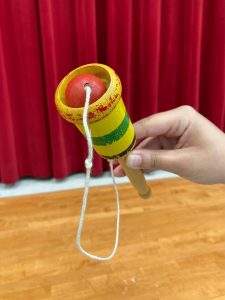
Ball and cup game from Chester County History Center collection. Photo: Chester County History Center Help with household and farm chores. Children planted seeds, pulled weeds, fed animals, milked cows and carried water.
- Read the Bible. For many families, especially Quakers and other religious communities, reading was tied closely to faith, with the Bible being a key book.
- Make simple toys. Tops, sticks, hoops and dolls made of corn husks and fabric scraps could all become playthings.
- Play quick games. Tag, catch, cup-and-ball, graces and hoop-and-stick games fit into short breaks in children’s schedules of chores.
- Learn adult skills. Girls might sew or churn butter, while boys might help with tools, animals or trades. Childhood was preparation for work.
 Kim Andrews is part of the Chester County Community Foundation’s America 250 initiative and a nonprofit governance consultant. She wrote this article to raise awareness of Chester County’s role in our nation’s fight for freedom and build engagement for 2026, the 250th anniversary of the Declaration of Independence. For more information and to get involved visit America250ChesCo.org or CCCF250.org.