
Brandywine Stories: Chester County’s Revolutionary Nature
Where the outdoors meets the Revolution
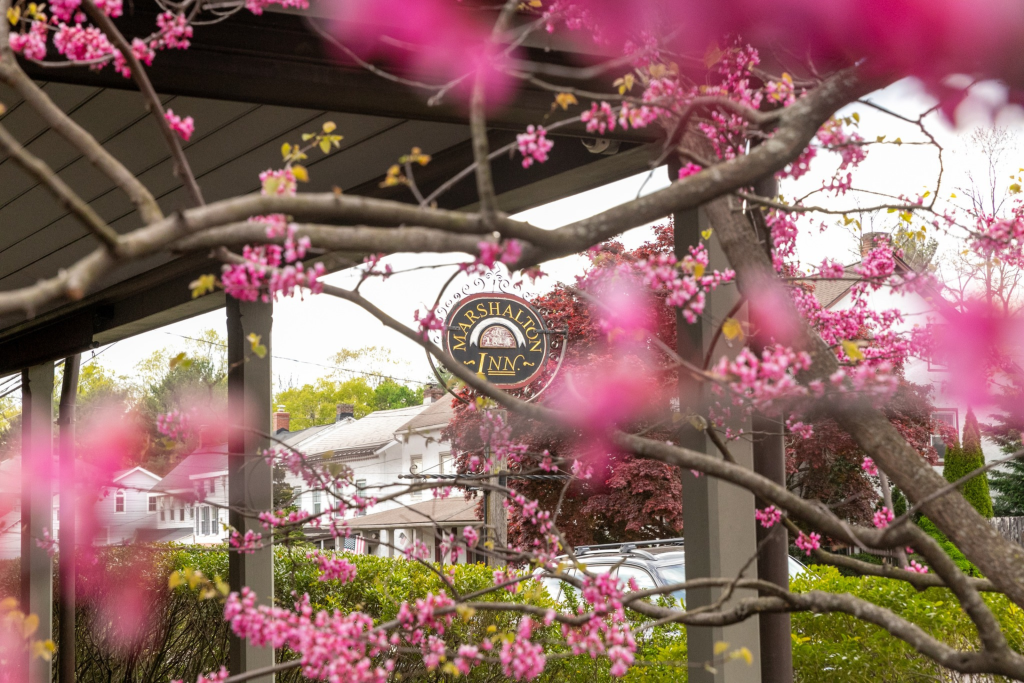
On any given weekend in Chester County, hikers lace up boots, cyclists trace winding backroads, and families spread picnic blankets beneath old trees. It’s easy to think of these landscapes as purely recreational — beautiful, restorative and comfortably removed from modern life.
Yet beneath many of today’s trails and meadows lies another story. During the Revolutionary War’s Philadelphia Campaign of 1777–1778, these same fields, fords and farm lanes became corridors of conflict, survival and transformation.
As the nation celebrates its 250th anniversary throughout 2026, Chester County offers a powerful reminder that meaningful commemoration doesn’t require distant cities or formal halls. It begins close to home, along the trails, parks and open spaces that quietly witnessed history in motion. Across the county, historic sites embedded within beloved recreation areas invite residents and visitors alike to experience the Revolution where it unfolded.
Local Geography and the Path of War
Chester County’s landscape was central to the war effort. Roads now favored by joggers once carried Continental and British troops. Creek crossings that attract anglers were strategic chokepoints. Farms that host community events today supplied grain, forage and shelter to armies on the move long ago. Chester County sat squarely in the path of the British advance toward Philadelphia, and its geography shaped decisions with consequences echoing far beyond the region.
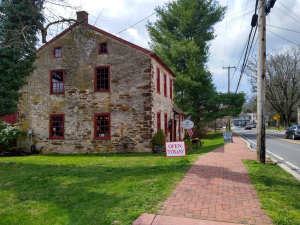
Now known for small shops and popular dining spots like the Marshallton Inn and Four Dogs Tavern, the village of Marshallton once anchored a crossroads pulsing with wartime discussion, supply routes and decision-making. A stroll along Strasburg Road reveals how ordinary places — taverns, shoemakers, wheelwrights and blacksmith shops — became vital nodes in a revolutionary network. The fight for independence was lived daily by civilians navigating uncertainty as much as by soldiers in uniform.
Further south, the landscapes of Kennett Square and Chadds Ford tell a story of movement and momentum. Trails and markers guide visitors through the terrain that witnessed the Battle of Brandywine, the largest land battle of the American Revolution. The scale of the conflict becomes tangible when walking or cycling these routes, revealing how fog, fields and waterways influenced the outcome.
The experience grows especially poignant at Paoli Battlefield, the site of the Paoli Massacre on September 21, 1777. Preserved open grasslands hold the memory of the nighttime attack that stunned the colonial soldiers. The quiet of the site, particularly at dusk, invites contemplation. Nature trails and interpretive panels help visitors understand not only what happened there, but why it mattered, connecting emotion with historical insight.
Agriculture Helped the War Effort
Not all Revolutionary stories center on combat. Chester County’s rich soil and mills formed a vital agricultural backbone, feeding residents and sustaining the war effort. Food production was as essential to independence as muskets and cannons.
Today, visitors can still hear the creak of wooden gears and smell freshly ground cornmeal at the Mill at Anselma (1747), a working gristmill in Chester Springs that operated during the Revolutionary period. Nearby, Thornbury Farm, located within the Brandywine Battlefield, offers a powerful dual narrative: once contested ground, now productive farmland supplying fresh food while welcoming families to connect with the land.

Northern Chester County also played a critical role. At Warwick County Park, wooded trails and rolling hills now offer a peaceful escape, but this land once supplied timber and charcoal for the region’s iron furnaces. Remnants of charcoal hearths remain along old cart paths, reminders that American independence was literally forged here through iron used to manufacture cannons and ammunition. Interpretive signage allows today’s visitors to layer historical understanding onto a casual hike.
At Historic Yellow Springs, trails wind past the remains of America’s first military hospital, commissioned by General George Washington in 1777, underscoring the region’s role in sustaining the Continental Army through care and recovery as well as combat.
Explore and Remember
Together, these sites demonstrate how outdoor recreation and historical commemoration reinforce one another. Families can follow loop trails and learn about colonial industry. Cyclists can link sites across landscapes that once challenged armies on foot. History enthusiasts can plan daylong outings that combine battlefield walks with village centers and county parks.
As America marks its semiquincentennial, Chester County’s outdoor spaces offer an accessible, deeply personal way to connect with the past. No tickets or timetables are required, just curiosity and a willingness to look more closely at familiar ground.
In 2026, in this countryside, a walk, ride or picnic is more than recreation, it’s a journey through history.
Our Revolutionary Nature
Hike Where They Marched
- Birmingham Hill Preserve. 1272 Birmingham Rd., West Chester. Brandywine.org/Conservancy
Site of first and second defensive lines of the Continental Army and where General Lafayette was wounded. 113-acre preserve with grass walking trail. - Brinton Run Preserve. 6 Oakland Rd., Chadds Ford. NorthAmericanLandTrust.org/Projects
71-acre preserve with trails and wildlife habitats within the Brandywine Battlefield. - Brandywine Battlefield Park. 1491 Baltimore Pk., Chadds Ford. BrandywineBattlefield.org
Museum, Washington’s headquarters and walking paths. - Jefferis Ford Nature Area. 35 N. Creek Rd., West Chester. EastBradford.org
11,000 British troops crossed the Brandywine at this corner on the morning of September 11, 1777. Interpretive panels and cycling stop. - Sandy Hollow Heritage Park. 1313 Birmingham Rd., West Chester. BirminghamTownship.org/History
Site of the second American defense during the Battle of Brandywine. 42-acre park with 1.1-mile pedestrian loop. - Paoli Battlefield Historical Park. Monument Ave & Wayne Ave., Malvern. PBPFInc.org
Remember Paoli! Site where 53 American troops were killed during a nighttime surprise attack. Trails and interpretive panels.
Wander Where They Worked
- Historic Yellow Springs. 685 Art School Rd., Chester Springs. YellowSprings.org
Walking tours, trails and exhibits explore America’s first military hospital, the spa village and the village’s role as a center for studying art, history and the environment. - The Mill at Anselma National Historical Landmark. 1730 Conestoga Rd., Chester Springs. AnselmaMill.org
Working c. 1747 grist mill and walking trails. Monthly milling demonstrations. - Thornbury Farm Market & CSA. 1256 Thornbury Rd., West Chester. ThornburyFarmCSA.com
Working farm since 1709, produce stand, events, tours of the battlefield. - Warwick County Park. 191 County Park Rd., Pottstown. ChesCo.org/4628/Warwick-County-Park
Walking trails, remains of iron industry.
Stroll Like a Patriot
- Marshallton Village Heritage Center. 1300 W. Strasburg Rd., West Chester. MartinsTavern.org
Info center and kiosk shares Marshallton’s village and landscape. Audio walking tour explores landmarks including Martin’s Tavern (1764) and the c. 1750 Blacksmith Shop.
Let Freedom Ring! Chester County’s Bells Across Pennsylvania
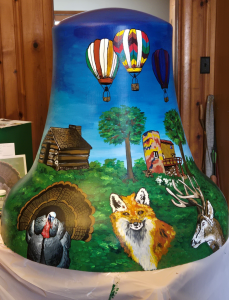
As part of America250PA’s Bells Across Pennsylvania initiative, artist-designed bells are being placed in all 67 counties to mark the 250th anniversary. Chester County’s bell, sponsored by the Chester County Community Foundation and designed by Chester Springs artist Ashley Kolpak, showcases local landmarks including Valley Forge National Historical Park, Longwood Gardens, Kennett Square’s Mushroom Capital heritage and the American Helicopter Museum.
Unveiled in spring 2026 at the Historic Chester County Courthouse, the bell will rotate among county civic and heritage sites over the next few years, serving as a visual call to Chester County’s Revolutionary roots and shared community pride.
 Kim Andrews is part of the Chester County Community Foundation’s America 250 initiative and a nonprofit governance consultant. She wrote this article to raise awareness of Chester County’s role in our nation’s fight for freedom and build engagement for 2026, the 250th anniversary of the Declaration of Independence. For more information and to get involved: America250Chesco.org or CCCF250.org